Friday, January 1, 2010

He Chose You to be Trophies of His Grace

"You yourselves, as living stones, are being built into a spiritual house for a holy priesthood to offer spiritual sacrifices acceptable to God through Jesus Christ." 1 Peter 2:5

God builds a palace for Himself in heaven, made of 'living stones'. Where did He get them? Has He brought forth the richest and the purest marble from the fine quarries of Paris? No! Christians, look to "the hole of the pit where you were dug out of, and to the rock where you were cut from!" You were full of sin. Far from being stones that were white with purity--you were black with defilement, seemingly utterly unfit to be stones in the spiritual temple, which would be the dwelling-place of the Most High God. And yet, He chose you to be trophies of His grace!

Goldsmiths make exquisite jewelry from precious materials; they fashion the bracelet and the ring from gold. But God makes His jewels out of base materials. From the black pebbles of the defiling brooks--He has taken up stones, which He has set in the golden ring of His immutable love, to make them gems to sparkle on His finger forever. He has not selected the best--but apparently the worst of men--to be the monuments of His grace!


~Grace Gems

Sunday, December 20, 2009

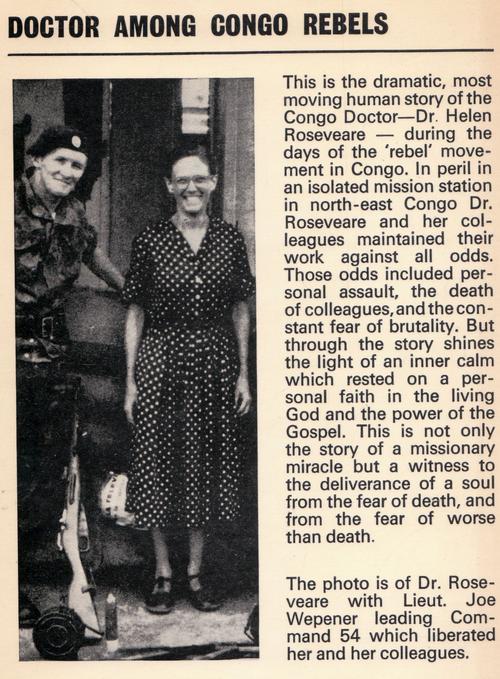
Helen Roseveare: Being a Missionary

"I believe that, at its simplest, a missionary is one sent by God to live a Christian life, usually amongst people other than his own. It is living which counts. This may include formal preaching, but it will certainly include personal relationships, and these often have to be worked out under most trying conditions. For example, many missionaries discover that it is far from easy to adapt themselves to a completely different climate. The native foods may be hard, not only on the digestive system, but also on the aesthetic tastes. The language barrier may constitute a difficult problem, especially in early years. One cannot choose one's friends. Two missionaries of vastly differing backgrounds, likes and dislikes, may be thrown together for several years with no choice of other companionship. One is often expected to do jobs for which one is not trained, and which may be actually distasteful. Yet in all this, one is called upon to reveal Christ, to live a Christ-like life, to be a 'missionary.'
It is then that one realizes it is not the journey in the steamer that changes one's nature. I did not escape from myself by going to Congo. Rather, I came to know myself better, perhaps more as others had already seen me. The ordinary trials and frustrations of life that meet us all were just as real in Congo, and, in some ways, were more pronounced, as there were fewer ways of avoiding or circumventing them. For myself, it was only as I allowed the Lord to show me my own pettiness, or willfulness, or pride, in different circumstances and problems, that I became willing to let the Lord teach me of Himself. 'Take my yoke upon you, and learn of me,' the Lord said, 'for I am meek and lowly in heart.' What happened in the two years following my first taste of success as a missionary doctor shows simply how very much I had to learn of Him, for surely no-one merited the description of Christ-likeness less than I, if it was to involve the phrase 'meek and lowly in heart.'


~Give Me This Mountain, pages 85 & 86

Saturday, December 19, 2009

The Bride of Christ

"Then I saw a new heaven and a new earth, for the first heaven and the first earth had passed away, and there was no longer any sea. I saw the Holy City, the new Jerusalem, coming down out of heaven from God, prepared as a bride beautifully dressed for her husband. And I heard a loud voice from the throne saying, "Now the dwelling of God is with men, and he will live with them. They will be his people, and God himself will be with them and be their God. He will wipe every tear from their eyes. There will be no more death or mourning or crying or pain, for the old order of things has passed away."

Wednesday, December 16, 2009

Perseverance of the Saints

"Do I confess that I am being preserved by God's keeping power? Then his preserving must be coming to light in my persevering. The only proof I have that he preserves me is that by his grace, I am enabled to persevere." ~A.N. Martin

"Faith alone saves, but the faith that saves is never alone." ~Anonymous

Tuesday, December 8, 2009

The Story of William Carey

Carey was born in a small thatched cottage in Paulerspury, a typical Northamptonshire village in England, August 17, 1761, of a weaver's family. When about eighteen he left the Church of England to "follow Christ" and to "...go forth unto Him without the camp, bearing His reproach." At first he joined the Congregational church at Hackleton where he was an apprentice shoemaker. It was there he married in 1781. And it was in Hackleton he began making five-mile walks to Olney in his quest for more spiritual truth. Olney was a stronghold of the Particular Baptists, the group that Carey cast his lot with after his baptism, October 5, 1783. Two years later he moved to Moulton to become a schoolmaster — and a year later he became pastor of the small Baptist congregation there.

It was in Moulton that Carey heard the missionary call. In his own words he cried, "My attention to missions was first awakened after I was at Moulton, by reading the Last Voyage of Captain Cook." To many, Cook's Journal was a thrilling story of adventure, but to Carey it was a revelation of human need! He then began to read every book that had any bearing on the subject. (This, along with his language study — for at twenty-one years of age Carey had mastered Latin, Greek, Hebrew and Italian, and was turning to Dutch and French. One well called his shoemaker's cottage "Carey's College," for as he cobbled shoes along with his preaching he never sat at his bench without some kind of a book before him.)

The more he read and studied, the more convinced he was "the peoples of the world need Christ." He read, he made notes, he made a great leather globe of the world and, one day, in the quietness of his cobbler's shop — not in some enthusiastic missionary conference — Carey heard the call: "If it be the duty of all men to believe the Gospel ... then it be the duty of those who are entrusted with the Gospel to endeavor to make it known among all nations." And Carey sobbed out, "Here am I; send me!"

To surrender was one thing — to get to the field was quite another problem. There were no missionary societies and there was no real missionary interest. When Carey propounded this subject for discussion at a ministers' meeting, "Whether the command given to the apostles to teach all nations was not obligatory on all succeeding ministers to the end of the world, seeing that the accompanying promise was of equal extent," Dr. Ryland shouted, "Young man, sit down: when God pleases to covert the heathen, He will do it without your aid or mine." Andrew Fuller added his feelings as resembling the unbelieving captain of Israel, who said, "If the Lord should make windows in heaven, might such a thing be!"

But Carey persisted. he later said of his ministry, "I can plod!" And he was a man who "always resolutely determined never to give up on any point or particle of anything on which his mind was set until he had arrived at a clear knowledge of his subject."

Thus Carey wrote his famed Enquiry Into the Obligations of the Christians to Use Means for the Conversion of the Heathen. In this masterpiece on missions Carey answered arguments, surveyed the history of missions from apostolic times, surveyed the entire known world as to countries, size, population and religions, and dealt with the practical application of how to reach the world for Christ!

And he prayed. And he pled. And he plodded. And he persisted. And he preached — especially his epoch-producing message, "EXPECT GREAT THINGS FROM GOD. ATTEMPT GREAT THINGS FOR GOD." The result of that message preached at Nottingham, May 30, 1792 — and all the other missionary ministries of Carey — produced the particular Baptist Missionary Society, formed that Fall at Kettering on October 2, 1792. A subscription was started and, ironically, Carey could not contribute any money toward it except the pledge of the profit from his book, The Enquiry.

It was in 1793 that Carey went to India. At first his wife was reluctant to go — so Carey set off to go nevertheless, but after two returns from the docks to persuade her again, Dorothy and his children accompanied him. They arrived with a Dr. Thomas at the mouth of the Hooghly in India in November, 1793. There were years of discouragement (no Indian convert for seven years), debt, disease, deterioration of his wife's mind, death, but by the grace of God — and by the power of the Word — Carey continued and conquered for Christ!

When he died at 73 (1834), he had seen the Scriptures translated and printed into forty languages, he had been a college professor, and had founded a college at Serampore. He had seen India open its doors to missionaries, he had seen the edict passed prohibiting sati (burning widows on the funeral pyres of their dead husbands), and he had seen converts for Christ.

On his deathbed Carey called out to a missionary friend, "Dr. Duff! You have been speaking about Dr. Carey; when I am gone, say nothing about Dr. Carey — speak about Dr. Carey's God." That charge was symbolic of Carey, considered by many to be a "unique figure, towering above both contemporaries and successors" in the ministry of missions.


*http://www.wholesomewords.org/missions/biocarey.html

Sunday, November 29, 2009

J.I. Packer, on Calvinism


"The five points, though separately stated, are really inseparable. They hang together; you cannot reject one without rejecting them all, at least in the sense in which the Synod meant them. For to Calvinism there is really only one point to be made in the field of soteriology: the point that God saves sinners. God—the Triune Jehovah, Father, Son and Spirit; three Persons working together in sovereign wisdom, power and love to achieve the salvation of a chosen people, the Father electing, the Son fulfilling the Father’s will by redeeming, the Spirit executing the purpose of Father and Son by renewing. Saves—does everything, first to last, that is involved in bringing man from death in sin to life in glory: plans, achieves and communicates redemption, calls and keeps, justifies, sanctifies, glorifies. Sinners—men as God finds them, guilty, vile, helpless, powerless, unable to lift a finger to do God’s will or better their spiritual lot. God saves sinners—and the force of this confession may not be weakened by disrupting the unity of the work of the Trinity, or by dividing the achievement of salvation between God and man and making the decisive part man’s own, or by soft-pedaling the sinner’s inability so as to allow him to share the praise of his salvation with his Saviour. This is the one point of Calvinistic soteriology which the “five points” are concerned to establish and Arminianism in all its forms to deny: namely, that sinners do not save themselves in any sense at all, but that salvation, first and last, whole and entire, past, present and future, is of the Lord, to whom be glory for ever; amen."

Wednesday, November 25, 2009

Zambia Update

Here is the latest blog update on the Reece families who moved to Zambia earlier in the year to serve as missionaries. Please pray for their endeavors as they labor in this country and adjust to their new home.

~~~~~~~~~~~~~~~~~~~~~~~~~~~~~~~~~~~~~

Progress on the camp pavilion is painfully slow but the structure is going up little by little everyday. The foundation walls and footings have been laid and the floor leveled. Seventeen teak posts are in the ground. For those who may wonder, we don't use teak to be extravagant. We use it because it's strong and it's the locally available building material of choice among the Lozi. Each teak pole costs about $3 USD. The bond beam (they call it a "ring beam" here) is almost finished. It is made up of seventeen beams running horizontally from post to post all around the perimeter of the structure. Four beams still need to be added and then it will be complete. The earth bag wall that separates the kitchen from the showers/bathroom area is almost finished. When we stand on it the bond beam (which is about nine-and-a-half feet up in the air) it is about waist high. One more hard day and I think we'll have it done. After that we will start on teak cross beams. Then teak king posts. Then mopani ridge poles and rafters. The last step before thatching will be to add small sticks called "lats" that will span between rafters and run parallel with the top of the wall. The bundles of thatch will be tied to the "lats". Vincent, our "foreman", is supposed to have a crew working on the storage room walls of the pavilion so that it will be finished when we get back. He needs monitoring so this could be interesting leaving him alone to manage this part. He's using the traditional Lozi building method called kukangala (adobe mud packed around a stick frame "matrix" - also referred to in England as waddle and daub).

A quick note about Vincent. He is very pleasant to work with. He's responsible, faithful, intuitive and shows initiative. I think he's a keeper. We continue to pray that the Lord will truly save him. It's possible that his heart has already been made new and he is trusting in Christ alone for salvation but just doesn't know how to express it in words.

So the Lord gave us a good gift the other day. Sean and I took Vincent with us to a place between Mwandi and Kazangula to see if we could buy some Mopani poles that I had seen in huge piles on the side of the highway. After driving two-and-a-half hours we were told that the man who owned them was building a lodge in Livingstone and was not willing to sell. I was praying and asking the Lord to help my attitude because it seemed that the whole trip was a waste. One of the old women suggested that we try to phone the man and, after a while provided his number. We took the old woman with us to where we could find a network signal. As it turned out we ran into a man who had cut all the trees for the guy building the lodge. He took us way out into the bush (30 more minutes) to his pile of poles out in the forest. He sold them to us for K 5,000 per pole which is about $1 per pole. To put that in perspective... these poles are at least twelve feet long and at least six inches in diameter, the strength of teak and the color of pine. Vincent was shocked at the quality of the wood and the low price. That made us feel pretty good about it. It was also a great testimony for him to see the Lord provide. It was a long day - Twelve hours altogether. But it was worth it. We pulled into camp at nine p.m. that night with 25 poles. Hopefully we can get 50 more from this same guy.

The rains have started but we are praying that we can be moved into this by Christmas! Thank you for continuing to pray.

~Shannon Reece

Response to the Gracious Summons


Saturday, November 7, 2009

The Conversion of William Wilberforce

"It is a great story of the providence of God in pursuing a person through seemingly casual choices. On the long holidays when Parliament was not in session, Wilberforce would sometimes travel with friends or family. In the winter of 1784, when he was twenty-five, on an impulse he invited Isaac Milner, his former schoolmaster and friend from grammar school, who was now a tutor in Queens College, Cambridge to go with him and his mother and sister to the French Riviera. To his amazement Milner turned out to be a convinced Christian without any of the stereotypes that Wilberforce had built up against the evangelicals. They talked for hours about the Christian faith.

In another seemingly accidental turn, Wilberforce saw lying in the house where they were staying a copy of Philip Doddridge's The Rise and Progress of Religion in the Soul (1745). He asked Milner about it, and Milner said that it was "one of the best books ever written" and suggested they take it along and read it on the way home. Wilberforce later ascribes a huge influence in his conversion to this book. When he arrived home in February 1785 he "had reached intellectual assent into the Biblical view of man, God, and Christ." But he would not yet have claimed what he later described as true Christianity. It was all intellectual. He pushed it to the back of his mind and went on with political and social life.

That summer Wilberforce traveled again with Milner, and they discussed the Greek New Testament for hours. Slowly his "intellectual assent became profound conviction." One of the first manifestations of what he called "the great change"--the conversion--was the contempt he felt for his wealth and the luxury he lived in, especially on those trips between Parliamentary sessions. Seeds were sown almost immediately at the beginning of his Christian life, it seems, of the later passion to help the poor and to turn all his inherited wealth and his naturally high station into a means of blessing the oppressed."


~From John Piper's "The Roots of Endurance," pages 124-125

Friday, November 6, 2009

We Begin to be Like Christ

(J. R. Miller, "The Life of Jesus")

"I am among you as one who serves." Luke 22:27

"He got up from supper, laid aside His robe, took a towel, and tied it around Himself. Next, He poured water into a basin and began to wash His disciples’ feet and to dry them with the towel tied around Him." John 13:4-5

Serving is not an easy lesson to learn. But it is a lesson we must learn--if ever we would become like our Master. He did not come to be served--but to serve. He served to the uttermost, just as He loved to the uttermost. Anything that needed to be done for another, He did as naturally and as simply as He breathed. He loved people, and was interested in them, and was ready always to be helpful to them. It never mattered what the service was, whether it was the saving of a soul, the curing of a grievous sickness, or the giving of a cup of water--He did the least as graciously and as divinely, as the greatest.

The washing of feet was the lowliest service any man could do for another. It was the work of the lowliest slave. Yet Jesus without hesitation, did this service for His own disciples. Thus He taught them that nothing anyone may ever need to have done--is unfit for the whitest hands. We begin to be like Christ--only when we begin to love others enough to serve them.

There is no surer test of the genuineness of Christian life, than in this matter of serving others. When we see the Son of God washing His disciples' feet--no service is too menial for us to do. A king may do the lowliest kindness to the poorest peasant in his realm, and his honor will only be enhanced by it.

"Now that I, your Lord and Teacher, have washed your feet--you also should wash one another's feet." John 13:14